Historical Population Database of Transylvania (HPDT)
The Historical Population Database of Transylvania (hpdt.ro) is one of the core research infrastructures developed by the Centre for Population Studies. The database contains demographic information on hundreds of thousands of individuals from Transylvania covering the period between the mid-nineteenth and early twentieth centuries.
HPDT was designed according to international methodological standards used in historical population research and is compatible with the Intermediate Data Structure (IDS) format, allowing integration and comparison with similar databases developed in Europe and North America.
The database enables longitudinal analyses of demographic behaviour, family structures, marriage patterns, mortality, and social mobility, serving as an essential tool for research in historical demography and social history.
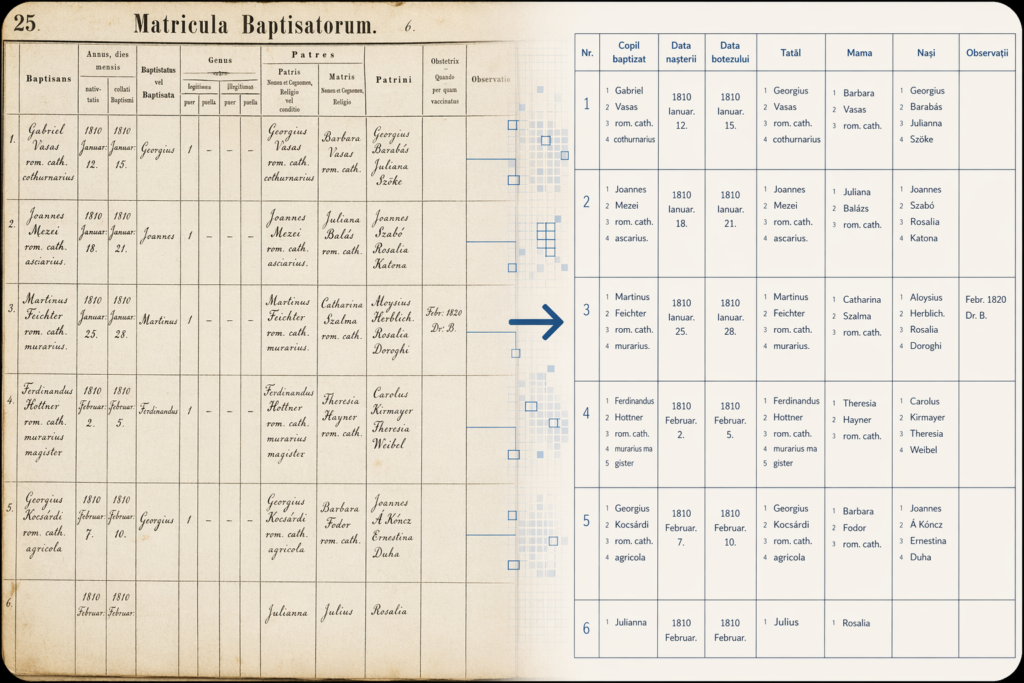
At present, HPDT continues to expand significantly through the integration of new data generated by automatic handwriting recognition models applied to civil registration records, which allow the large-scale extraction and processing of historical demographic information.
Transylvania Health Database (TRHD)
The Transylvania Health Database (trhd.ro) is a digital research infrastructure developed by the Centre for Population Studies to support interdisciplinary research on health, disease, and medical care in historical populations.
The database is structured around three main components: medical personnel, patients, and medical institutions, allowing researchers to reconstruct the functioning of historical healthcare systems and the interaction between practitioners, institutions, and the population.
TRHD is built on a wide range of historical sources, including administrative records, hospital registers documenting patients and deaths, and other institutional documents. By integrating these materials into a structured database, TRHD enables the study of morbidity, mortality, medical practice, and public health patterns in Transylvania’s past.
The database supports research at the intersection of social history, historical demography, and the history of medicine, offering new opportunities for analysing health inequalities, disease patterns, and the development of medical institutions in historical societies.
Probate Database of Transylvania (PDT)
The Probate Database of Transylvania (db.probatetransylvania.ro) is a relational database developed at the Center for Population Studies, modeled after the HPDT. It integrates various types of information from probate records in Transylvania; the sources processed to date primarily cover the cities of Sibiu (and its surroundings) and Brașov, and date from the period 1680–1830.
The PDT comprises several tables, structured both according to the existing infrastructure with which it is compatible (HPDT) and according to the specific content and structure of the processed sources. Currently, the database contains information on 8,600 individuals appearing in 4,700 estate divisions, as well as on over 4,400 objects and 4,500 dwellings.
The information processed to date has been used to track the economic impact of the 1738–1739 plague on the wealth of Sibiu’s inhabitants, as well as to outline the socioeconomic profile of those who died in the city between 1750 and 1800.
Invalids, Orphans and War Widows Database (IOW database)
The Invalids, Orphans and War Widows Database (IOW database) represents a digital research infrastructure dedicated to the study of the social consequences of the First World War in Transylvania. It brings together information extracted mainly from the pension files of those who suffered as a result of the war, containing detailed data on war invalids, widows, and orphans.
The sources concerning invalids include civil status documents, reports on the physical characteristics of soldiers, information about their participation in the war, testimonies regarding the disappearance or death of soldiers, medical records, as well as data related to family situation and the pensions granted. The sources relating to widows contain information about the widow’s identity, details about the soldier husband, marriage information, his participation in the war, and the pension granted to the family. Meanwhile, the sources concerning orphans bring together data about the children, their parents, the father’s participation in the war, the legal guardian, and the benefits received.
The database was designed according to modern principles of digital history and follows a source-oriented relational structure that reproduces as faithfully as possible the information contained in the original documents. The database model includes main tables dedicated to invalids, widows, and orphans, complemented by secondary and auxiliary tables concerning children, events, localities, military units, ranks, and family relationships.
The IOW database enables interdisciplinary analyses in fields such as social history, historical demography, military history, and the history of medicine. At the same time, it facilitates the reconstruction of the life experiences of past inhabitants of Transylvania and highlights aspects of the First World War that have remained little known in this province, which once was part of the former Austro-Hungarian Monarchy.